
Introduction to UR (SN25)

Use ← → to move through the deck, F for fullscreen.
In this deck
- 01 · Introduction to SN25
Introduction to SN25
An introduction to UR, Bittensor subnet 25, dated August 2026.
- 02 · Current State
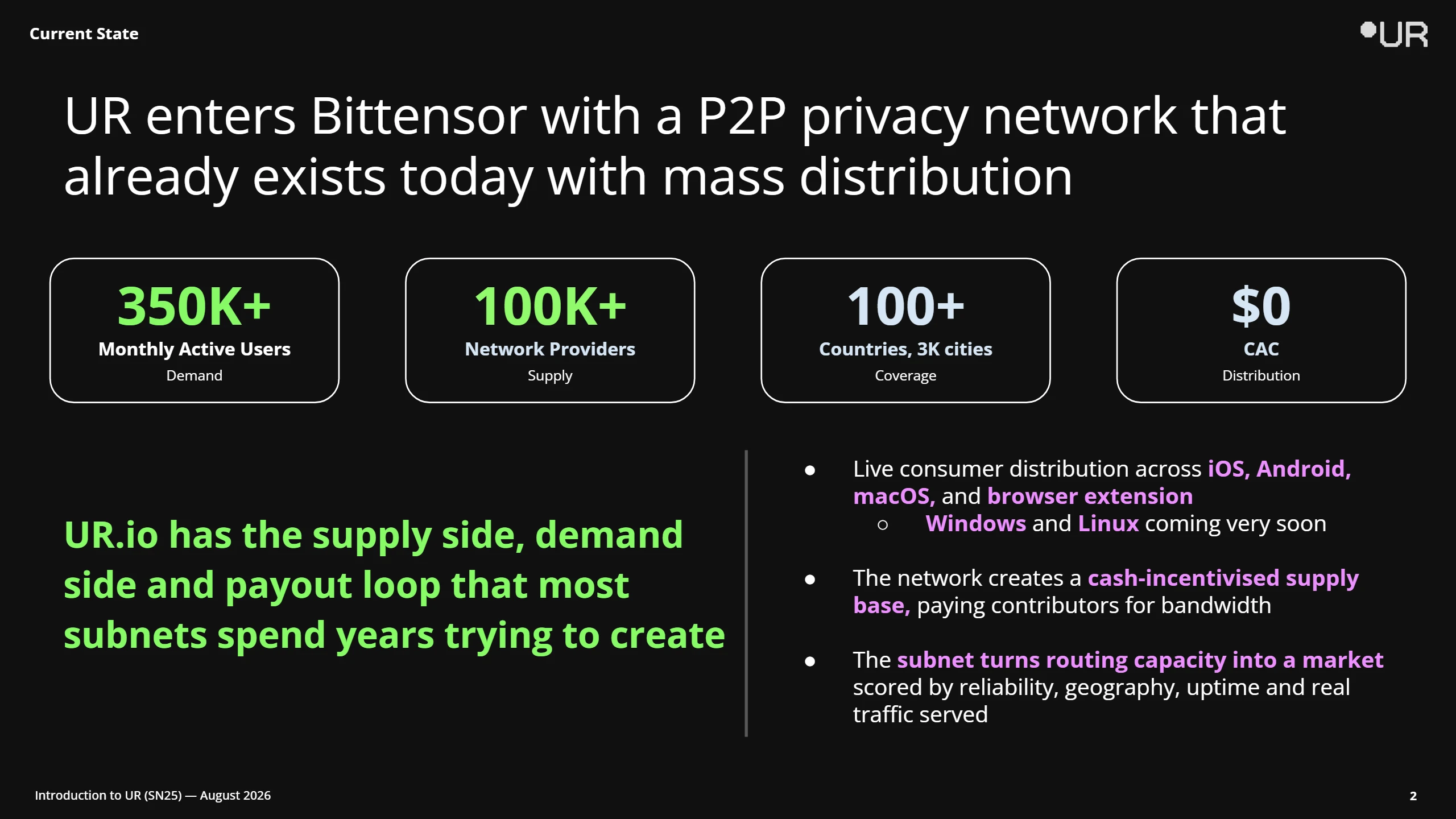
UR enters Bittensor with a P2P privacy network that already exists today with mass distribution
The network already has demand (350K+ monthly active users), supply (100K+ network providers), coverage (100+ countries) and distribution ($0 CAC): live consumer apps on iOS, Android, macOS and the browser, with Windows and Linux coming soon. It pays contributors for bandwidth, and the subnet turns routing capacity into a market scored by reliability, geography, uptime and real traffic served.
- 03 · The Mission
Big Internet centralises the path; open networks distribute it
Big Internet runs on finite data-centre fleets, one company controls the path, known infrastructure can be enumerated or blocked, and the margin accrues to the platform. The UR internet draws residential capacity from independent operators, distributes routes across a broader supply base, has no single fixed fleet that defines the target, and measures and rewards useful reachability.
- 04 · Product & Research Pipeline
P2P encryption network is unlocking new research paths
ur.io is the live product: 350K+ monthly actives whose usage creates network demand. Three research programmes build on the same subnet: Project Bastion (how do we unlock enterprise network connectivity?), Project Stargate (can one open index support model training and live retrieval?) and Project Meridian (how do we create dedicated identity for agents?). The subnet is the shared provider and validation layer, 100K+ residential providers in 100+ countries, and supports them all through quality scoring and an incentive market.
- 05 · Subnet Design
Validators measure performance before emissions reach miner UIDs
Users use the app and the network operator (ur.io, for example) pays in SN25. Validators test uptime, transfer and proof-of-transit before emissions reach miner UIDs: about 200 top miners own UIDs, and about 100K long-tail miners, the residential IP providers, take part through pools. Chain emissions, in alpha net of burn, pay the miner UIDs.
- 06 · Demand expansion
UR will create an ecosystem of network operators
Live today: ur.io, a consumer VPN with 350K+ MAU. In the research pipeline: Project Bastion (enterprise access), Project Stargate (an open web index) and Project Meridian (a corporate mesh). Areas of interest: a competing VPN, an agent-infrastructure startup, a data business, or something not yet imagined. UR (SN25) is one settlement layer, billed on MAU × GB/day and paid in alpha: operators acquire SN25 to use the network, miners are paid SN25 on real usage, and a denser network attracts the next operator.
- 07 · Value Accrual
The same UR miner fleet can scale network operators asymmetrically
One operator (ur.io today), three (with Projects Meridian and Stargate) or N (with third parties and new companies) all run on an identical 100K-node miner fleet, so SN25 bought scales 1× → 3× → N×. The more users and data network operators drive, the more valuable the network, and the same fleet monetises idle supply.
- 08 · Request for Operators
Multiple businesses ready to be built on UR
Six example starting briefs, placed by users served and data moved per customer, each with a Web2 comparable: a white-label VPN (Mozilla VPN, 2M subscribers), encrypted business mail (Proton, $134M revenue), the agent access layer (Browserbase, $300M valuation), AI answer visibility (Profound, $1B valuation), ad verification (DoubleVerify, ~$1.7B public) and private LLM search (DuckDuckGo, $200M revenue). The network fee is MAU × price per user plus GB × price per GB.
- 09 · Our Goal
Bittensor can scale UR from regional depth to global density, targeting 1B+ users
Open competition creates an incentive to deepen the provider supply market. Before: real density in the US and Southeast Asia, funded entirely by UR, with a practical ceiling of about 1M monthly actives before capacity per country runs out. After: that depth in every market, the subnet paying for coverage so density compounds market by market, and an addressable population of about 1B once density is no longer the binding constraint.
- 10 · Why Bittensor
Bandwidth is Bittensor’s next major commodity
Bittensor already runs commodity markets for compute (Lium, SN51), storage (Hippius, SN75) and inference (Engy, SN53, verified frontier open models). Bandwidth is the supply gap, and the UR Subnet (SN25), a peer-to-peer encryption network, is next.
- 11 · Web2 Comparables
Enterprise and consumer privacy are multi-billion dollar markets
Consumer privacy: Proton VPN ($134M revenue), NordVPN ($3B valuation) and DuckDuckGo ($200M revenue), which grew from encrypted email, VPN-led distribution and private search. Enterprise privacy: Zscaler ($3.36B ARR, 25% YoY growth), Cloudflare ($2.81B revenue, 30% YoY growth) and Tailscale ($1.5B valuation), which replaced perimeter VPNs with zero trust, extended network infrastructure into private access, and turned developer-led mesh networking into enterprise demand.